
Why IT architecture Dictates PLM Success
If your PLM system feels like a static digital archive rather than a dynamic innovation engine, the problem isn’t necessarily the software; it’s the foundation it sits on. In 2026, successful PLM architecture design has evolved from a simple repository for engineering data into a sophisticated data-orchestration layer. As platforms like Siemens Teamcenter and PTC Windchill integrate advanced AI assistants, the underlying IT structure determines whether these tools provide actual value or just add to your technical debt.
You probably recognize the friction caused by data silos between engineering and production. It’s a common challenge that prevents many organizations from reaching true digital maturity or leveraging the latest AI-driven insights. We’ll show you how modernizing your architecture from monolithic silos to AI-ready, integrated ecosystems can eliminate these bottlenecks and drive manufacturing excellence. This guide examines the shift toward composable frameworks and provides a roadmap for building a scalable, cloud-ready environment that supports the full product lifecycle and ensures long-term technical agility.
Key Takeaways
- Learn why shifting from monolithic systems to composable frameworks is essential for modern PLM architecture design and long-term technical agility.
- Understand the methodologies for integrating PLM with ERP and MES to achieve a closed-loop manufacturing environment that connects engineering to the shop floor.
- Discover how to structure high-quality metadata and data schemas to ensure your industrial ecosystem is prepared for AI and Large Language Models.
- Identify why establishing a comprehensive digitalisation vision with an independent partner is a prerequisite for successful system implementation and tool selection.
Table of Contents
- Defining Modern PLM Architecture Design in 2026
- Transitioning from Monolithic to Composable PLM Frameworks
- Evaluating Core Components: ERP, MES, and MOM Connectivity
- Designing for AI and Industrial Digitalisation Readiness
- Navigating Implementation with a Strategic Architecture Partner
Defining Modern PLM Architecture Design in 2026
Modern manufacturing demands more than just a place to store CAD files. Strategic PLM architecture design serves as the central nervous system of the enterprise, coordinating data from initial concept through to end-of-life recycling. It’s the essential backbone of the Digital Twin, providing the high-fidelity data stream required to simulate physical performance in a virtual environment. While traditional views focused on storage, 2026 standards prioritize data orchestration. This means moving information fluidly between stakeholders rather than letting it sit in isolated databases.
Successful implementations distinguish between system architecture and solution architecture. System architecture deals with the IT infrastructure, cloud scalability, and security protocols. Solution architecture focuses on the business logic, ensuring the tools actually solve engineering bottlenecks. Bridging this gap requires vendor-independent consulting. Independent advisors provide the objectivity needed to design a system that prioritizes your operational requirements over a software vendor’s specific feature set. As defined by Product Lifecycle Management (PLM), the discipline covers the entire product journey, making it too critical to leave to biased perspectives.
The Shift from Software to Data-Centric Design
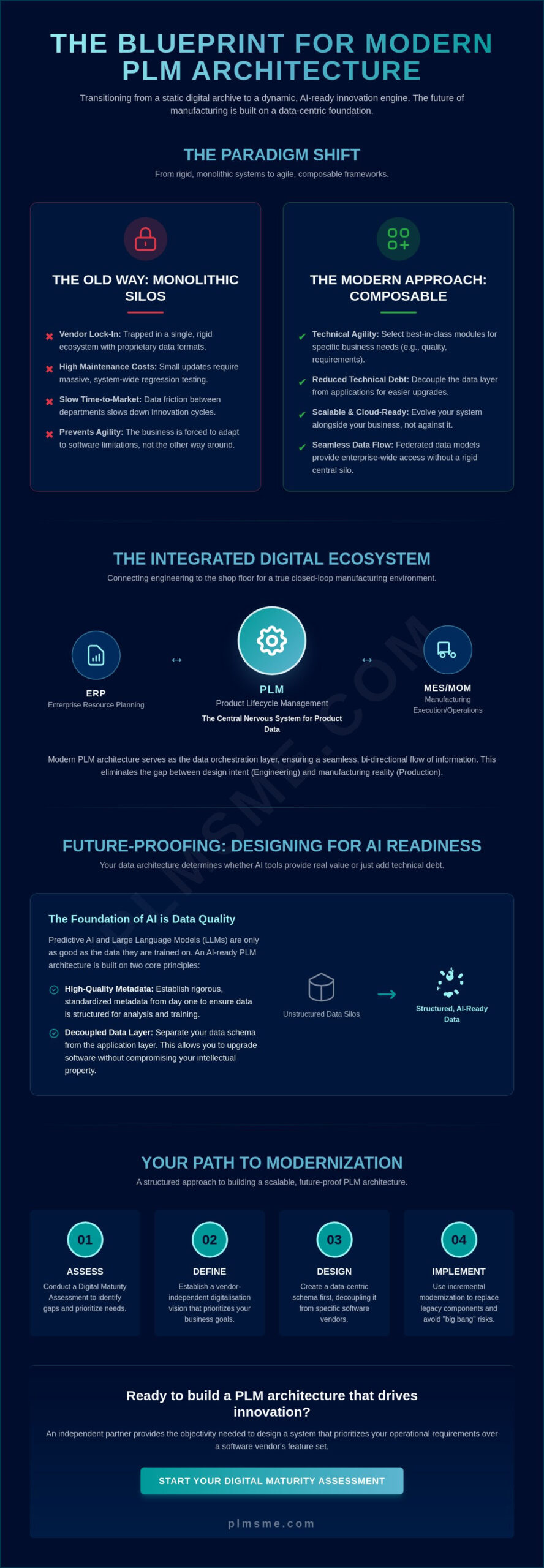
In the past, companies chose a software vendor and then tried to fit their data into that vendor’s rigid schema. Today, that process is reversed. We define the data schema first to ensure it supports the long-term vision of the company. Decoupling the data layer from the application layer is a vital strategy for reducing technical debt. When data remains independent, you can upgrade or swap software modules without losing the integrity of your intellectual property. Modern PLM architecture is a multi-layered data ecosystem that facilitates seamless flow across disparate functional domains.
Aligning Architecture with Digital Maturity
Every architectural decision should stem from a clear understanding of your current state. A digital maturity report identifies existing gaps and helps prioritize which components of the PLM architecture design need immediate attention. A startup focused on rapid prototyping has different needs than a global discrete manufacturer managing thousands of SKUs. Your roadmap must include AI-ready milestones from day one. This involves establishing high-quality metadata standards early, ensuring that when you’re ready to deploy predictive AI or Large Language Models, your data is already structured for training and analysis.
Transitioning from Monolithic to Composable PLM Frameworks
Monolithic systems were once hailed as the ultimate solution for enterprise cohesion. However, these “one-size-fits-all” platforms often become anchors that prevent agility. A modern PLM architecture design prioritizes composability, allowing organizations to select best-in-class modules for specific functional needs, such as requirements management or quality control, without being forced into a single vendor’s entire stack. This modularity ensures the system evolves alongside the business, rather than forcing the business to adapt to software limitations.
The transition toward composability is particularly evident in the latest iterations of Siemens Teamcenter. Recent releases, including Teamcenter 2406 and 2506, have emphasized cloud readiness and platform modernization. These updates allow for a more modular architectural approach, where businesses can deploy specific capabilities as needed. This shift balances the necessity of a “Single Source of Truth” with the practical reality of federated data access, where information is accessible across the enterprise without being trapped in a rigid, centralized silo.
The Risks of Monolithic Lock-in
High maintenance costs are the primary symptom of rigid, legacy architectures. When every small update requires a massive, system-wide regression test, innovation slows to a crawl. These silos delay time-to-market because data remains trapped in proprietary formats that other departments can’t easily access. Incremental modernization provides a safer path forward. By slowly replacing legacy components with modern, cloud-native services, companies avoid the catastrophic risks of “big bang” implementations. If you’re unsure where your current system stands, conducting a digital maturity assessment can highlight which legacy components are creating the most friction.
Implementing Federated Data Models
Transitioning to a composable framework doesn’t mean abandoning the “Single Source of Truth.” Instead, it involves moving toward federated data access. This model uses microservices and standardized APIs to connect disparate systems, ensuring data integrity across global teams without centralizing every byte of information. The role of microservices in modern PLM architecture design is to act as lightweight, independent connectors that handle specific tasks, such as BOM synchronization or change management. Standardizing these APIs ensures that when a module is updated or replaced, the rest of the ecosystem remains stable and communicative. This creates a resilient environment where data flows naturally between engineering, procurement, and the shop floor.
Evaluating Core Components: ERP, MES, and MOM Connectivity
A high-performing PLM architecture design isn’t an island. Its value is realized through its ability to communicate with the systems that drive physical production and business operations. In a modern manufacturing environment, this requires mapping interactive connections between the PLM system and the shop floor. We focus on creating a “closed-loop” manufacturing environment, often visualized as the PLM-MES-MOM triangle. In this model, PLM provides the technical definition of the product, the Manufacturing Execution System (MES) manages the execution of the work, and Manufacturing Operations Management (MOM) provides the overarching visibility into the entire production process. When these three points are synchronized, engineering changes flow instantly to the floor, and production realities are fed back into design.
Establishing robust ERP integration is equally vital for cost and resource transparency. While PLM manages the “how” and “what” of a product, the ERP manages the “when” and “who,” including procurement, inventory, and logistics. Without a seamless connection, businesses face redundant data entry and costly errors in the supply chain. This is why Teamcenter integration development is critical for data continuity. With recent releases like Teamcenter 2506 and 2512 focusing on platform modernization and AI readiness, the technical requirements for these integrations have become more sophisticated. Ensuring that data remains consistent as it moves from a CAD model to a purchase order requires a deep understanding of both the software’s API capabilities and the business logic of the manufacturing process.
Bridging the Gap Between Engineering and Production
The transition from an Engineering Bill of Materials (EBOM) to a Manufacturing Bill of Materials (MBOM) is a frequent point of failure in fragmented systems. A well-designed architecture automates this flow, ensuring that manufacturing engineers work with the latest design data. MES integration takes this a step further by enabling real-time feedback. When a technician encounters a fitment issue on the assembly line, that data can be captured and sent back to engineering for immediate design iteration. Additionally, ensuring CRM connectivity allows customer-driven requirements to influence the initial design phase, creating a truly market-responsive lifecycle.
Best Practices for System Integration Development
Choosing between middleware and direct API connections is a pivotal decision in PLM architecture design. While direct APIs offer high performance for specific tasks, middleware provides a flexible orchestration layer that’s often easier to maintain as your system scales. Maintaining data synchronization is particularly challenging during high-volume migration projects, where even minor latency can cause version conflicts. To reduce latency in global PLM-ERP data exchanges, we often implement asynchronous data transfers. This approach ensures that local teams don’t experience system lag while waiting for massive data packets to sync across international servers, maintaining high productivity levels regardless of geographic location. If your technical needs extend to specialized software development for digital transaction simulation systems, you can learn more about advanced tools for secure data flashing and system testing.
Designing for AI and Industrial Digitalisation Readiness
AI is no longer a speculative feature; it’s a core functional requirement for competitive manufacturing. Designing for AI-readiness means moving beyond basic data storage to creating highly structured data schemas that can feed Large Language Models (LLMs) and predictive algorithms. Without a rigorous PLM architecture design that prioritizes clean, contextualized data, AI tools will fail to deliver actionable insights. High-quality metadata acts as the primary fuel for these industrial models. It allows the system to understand not just what a part is, but how it behaves within a complex assembly and why it was manufactured in a specific way.
Effective architectures support autonomous decision-making by providing the necessary logic layers between the data and the shop floor. Your AI roadmap should dictate the selection of architectural components, ensuring that every integration point facilitates rather than hinders data flow. If your goal is predictive maintenance or automated quality control, your infrastructure must be capable of handling high-velocity data streams in real-time. For organizations looking to bridge this gap, our industrial automation and AI solutions provide the framework needed to transform raw data into a strategic asset.
AI-Ready Data Pipelines in PLM
Establishing “clean” data lakes is the first step toward meaningful industrial analysis. Unlike traditional databases, these lakes store vast amounts of raw data that smart PLM architecture can automatically classify using machine learning scripts. This removes the manual burden of data entry and ensures that the information remains consistent across the lifecycle. AI readiness is a byproduct of structured PLM design that treats data as a fluid, reusable commodity rather than a static file.
Future-Proofing for Industrial Automation
Integrating IoT sensor data directly into the PLM environment allows for a living Digital Twin that reflects real-world performance. This data stream can also support augmented reality (AR) applications, providing assembly workers with real-time digital overlays based on the latest engineering specifications. Evaluating the scalability of platforms like Siemens Teamcenter is essential, especially with the introduction of “Teamcenter Copilot” in the latest 2026 releases. These AI-driven assistants require an architecture that can scale rapidly as the volume of processed data grows, ensuring that the system remains responsive during peak production periods.
Navigating Implementation with a Strategic Architecture Partner
Selecting the right partner is as critical as the software itself. A software vendor’s primary objective is often the distribution of licenses, whereas an independent consultant focuses on the structural integrity of your data ecosystem. When we approach PLM architecture design, we prioritize objectivity. This ensures the system architecture aligns with your long-term business goals rather than a specific vendor’s release cycle. Establishing a clear digitalisation vision is the first step. Without it, you risk implementing expensive tools that don’t communicate, creating new silos instead of breaking them down.
PLM-Sme FZC functions as a boutique specialist, bridging the gap between high-level vision and granular technical execution. We don’t just execute tasks; we engage as a thinking partner to ensure your architecture remains agile. Whether it’s providing end-to-end PLM implementation support or specialized Teamcenter integration development, our focus remains on tailored quality. This collaborative approach builds trust through transparency, ensuring that the final solution is both sophisticated and accessible to your technical specialists.
From Digital Maturity Assessment to Implementation
Every successful architecture project begins with a digital maturity report. This document identifies your current technical debt and maps a path toward AI-readiness. As a thinking partner, we help manage stakeholders across engineering and production to ensure the transition to a new PLM architecture design doesn’t disrupt ongoing operations. Clear communication helps align diverse teams with the new digital roadmap. This methodical progression from assessment to implementation ensures that each capability is clearly defined and validated before moving to the next phase of the project.
Ensuring Long-Term Architectural Health
Solution architecture is your best defense against future technical debt. It’s not a one-time setup but a continuous process of refinement. As your business grows and AI requirements evolve, your system needs constant tuning to maintain peak performance. This is where a PLM system administration retainer becomes invaluable. It provides the steady, professional oversight needed to maintain data integrity and system health. Ongoing support ensures your architecture scales alongside your manufacturing ambitions, allowing you to leverage new features without compromising stability. Establish your digitalisation roadmap with a professional assessment from PLM-Sme to ensure your infrastructure is ready for the challenges of 2026 and beyond.
Securing Your Manufacturing Future Through Architectural Excellence
The evolution of industrial digitalisation has made one thing clear; your software is only as effective as the structure supporting it. Transitioning to a composable PLM architecture design is no longer a luxury but a prerequisite for organisations aiming to deploy AI and maintain a true Digital Twin. By moving away from monolithic constraints and prioritising seamless connectivity with ERP, MES, and MOM systems, you create a foundation that scales with your manufacturing ambitions.
As a Siemens Digital Industries Alliance Partner, PLM-Sme FZC brings deep expertise in end-to-end Teamcenter implementation and complex enterprise integrations. We help you navigate the transition from legacy technical debt to an AI-ready ecosystem through grounded, objective advice. Whether you’re refining your data schemas or orchestrating a global system rollout, the right architectural strategy ensures your digital transformation delivers measurable results.
Request a Digital Maturity Assessment and Architecture Roadmap to begin your journey toward a more resilient and integrated manufacturing future. We look forward to partnering with you on your digitalisation vision.
Frequently Asked Questions
What is the difference between PLM system architecture and solution architecture?
System architecture focuses on the physical and virtual IT infrastructure, including servers, networking, and cloud services. Solution architecture addresses the business logic and functional requirements of the software. While system architecture ensures the platform is available and secure, solution architecture ensures the tool actually solves engineering challenges. Both must be aligned to prevent technical debt and ensure the system remains performant as user numbers grow.
How does PLM architecture design impact AI implementation in manufacturing?
A robust PLM architecture design determines the quality and structure of the data available for machine learning models. High-quality metadata and clean data schemas are essential for training predictive AI and Large Language Models. If the underlying architecture is fragmented, the AI will lack the context needed to provide accurate insights. A structured approach ensures data is “AI-ready” by standardising classifications across the entire product lifecycle.
Why is Siemens Teamcenter preferred for complex industrial architectures?
Siemens Teamcenter is preferred for its proven scalability and modularity in large-scale discrete manufacturing. Recent versions provide advanced cloud-native capabilities and deep integration with AI through tools like Teamcenter Copilot. Its ability to manage complex multi-CAD environments and massive datasets makes it the industry standard for global organisations. The platform’s flexible API framework also simplifies the development of custom integrations with other enterprise systems like ERP and MES.
Can PLM architecture be designed to integrate with any existing ERP?
Most modern PLM systems can integrate with any ERP, provided the PLM architecture design is built with interoperability in mind. This usually involves using middleware or direct API connections to synchronise BOM data and resource information. The key is ensuring data mapping is consistent between the two systems. A well-executed integration provides cost transparency and resource clarity by connecting engineering definitions with procurement and logistics realities.
What are the first steps in modernising a legacy monolithic PLM architecture?
The first step is conducting a comprehensive digital maturity assessment to identify existing technical debt and operational gaps. This report provides the baseline needed to create a strategic digitalisation roadmap. Instead of a risky “big bang” replacement, we recommend an incremental modernisation approach. This involves prioritising the most critical modules for transition to a composable framework, allowing for continuous improvement without causing significant system downtime.
How long does a typical PLM architecture design and implementation project take?
Project timelines depend on the organisation’s size and the complexity of its data. A strategic assessment and roadmap phase usually takes 4 to 8 weeks. A full-scale implementation for a mid-sized manufacturer might span 6 to 12 months. Large global enterprises often require 18 months or more to complete a phased rollout across multiple sites, ensuring that legacy data is migrated safely and users are properly trained.
Is a cloud-based PLM architecture more secure than on-premise for industrial data?
Cloud-based architectures often provide superior security because major providers invest heavily in infrastructure protection that individual companies can’t match. Cloud-native PLM platforms benefit from automated updates and advanced encryption protocols. However, the overall security of industrial data depends on the specific architecture design. It must balance global accessibility with strict access controls to protect sensitive intellectual property from unauthorised external or internal access; for those seeking a more rigorous validation of their defenses, Pentesys Limited offers professional penetration testing services tailored to complex IT infrastructures.